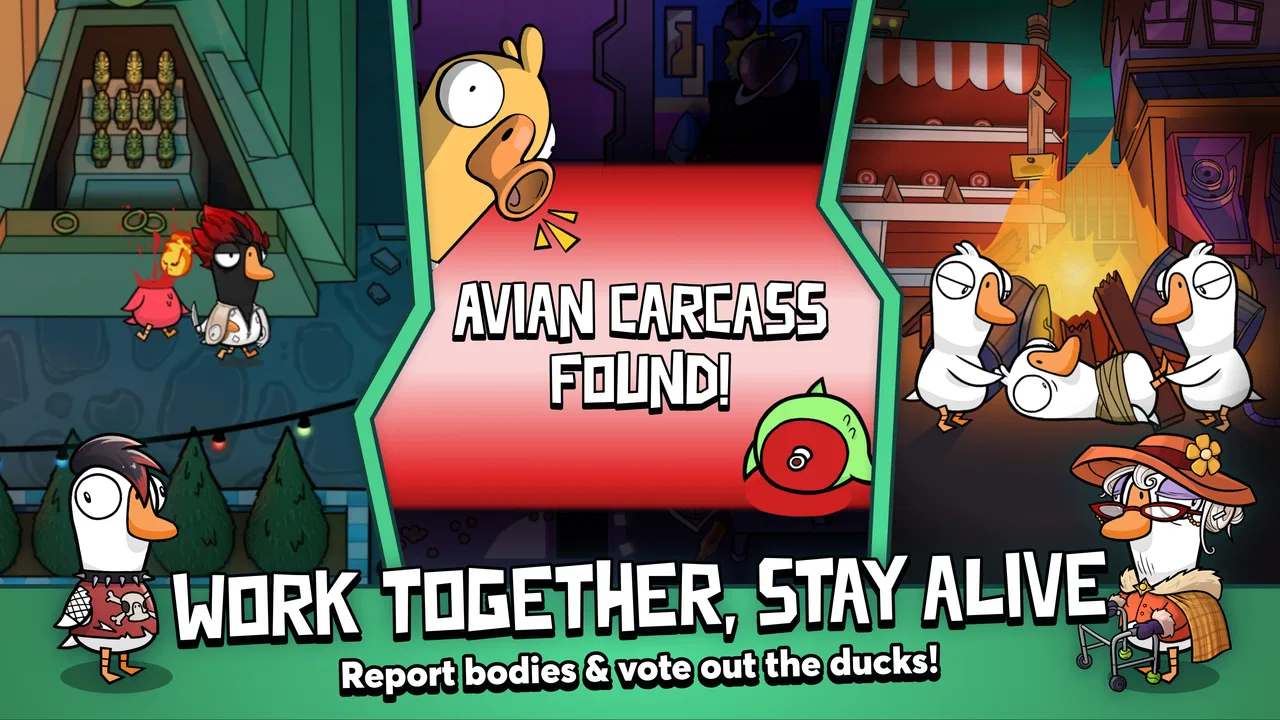
Goose Goose Duck
- 4.6
- Rating
- 10.00M
- Installs
- Free
- Price

 Analysis by App-foxy
I spent time with Goose Goose Duck as a social strategy game, paying particular attention to how comfortably it works in different situations and for different players. Its basic idea is easy to understand: players take the roles of geese, cooperate around shared objectives, and try to identify the hidden threats among them. The appeal is not in building an empire or collecting a long list of upgrades. It is in reading people, explaining your decisions, and surviving the confusion that develops when nobody can be completely trusted.
That makes it a very different experience from a conventional strategy game. I am not planning roads, managing resources, or arranging units on a map. Instead, I am watching behavior, remembering conversations, comparing alibis, and deciding when to speak. The game is free to start, and it comes from Gaggle Studios, Inc. Its Teen content rating is worth taking seriously, especially because the social side can become intense even when the cartoon presentation feels light.
How the presentation supports reading and navigation
The strongest accessibility quality I noticed is that the central task is conceptually clear. I always know that I am trying to complete my role, understand what other players are doing, and make useful decisions during discussions. That clarity matters because social deduction can otherwise become overwhelming: there may be movement, objectives, chat, accusations, and interruptions all competing for attention. Here, the match structure gives those actions a recognizable rhythm.
You May Also Like

 Blood Strike: 2.5 Anniversary
Blood Strike’s Loadouts Turn Every Drop Into a Tactical Gamble
A close look at Blood Strike’s custom loadouts: how fast access to signature weapons reshapes its battle royale rhythm, rewards preparation, and narrows the gap between fights.

 Pandora - Music & Podcasts
Pandora’s Music Is Easy to Start, but Harder to Recover
Pandora’s strength is its low-effort path from a seed to a station. Its weak spot is how much confidence it asks you to place in connection, setup, and quiet recovery.

 8 Ball Pool
 Is Built on Rivalries, Rematches, and Routine
A close look at the rivalries, rematches, shared routines, and unanswered safety questions that turn a quick pool match into a persistent mobile community.

 Samsung Music
’s Quiet Strength Is Playing What You Already Own
Its reach comes less from spectacle than from dependable access to a personal library. That simplicity is both the app’s strongest retention engine and its ceiling.

 AccuWeather: Weather Radar
AccuWeather Review: A Quick, Clear Forecast for Everyday Decisions
For everyday plans, the best forecast is the one you can understand quickly. AccuWeather makes rain timing, radar, and local conditions easy to act on, with a few trade-offs.

 Hill Climb Racing
Why Hill Climb Racing Still Turns Crashes Into One More Run
A tiny car, a bumpy hill and one more upgrade: Hill Climb Racing keeps resurfacing because its simple chaos makes every near-miss feel personal.
More From Our News Desk



Navigation is easiest when I treat each round as a sequence rather than trying to understand the whole game at once. I move through the environment, pay attention to nearby events, react when a meeting or discussion begins, and then return to the next phase. For a new player, this is more manageable than trying to memorize every possible role immediately. I recommend learning the basic flow first, then adding more complicated role knowledge after a few matches.
The visual style helps the game feel approachable, but it does not remove the need to concentrate. Small movements and brief encounters can become important evidence. If I look away at the wrong moment, I may miss who entered an area or who left it. That is a meaningful consideration for players who find busy screens tiring, who need frequent visual breaks, or who have difficulty tracking several moving characters at once.
Text-based discussion also affects readability. The game depends heavily on players sharing observations and defending themselves, so reading quickly can be useful. I found that short, direct messages work better than long explanations because meetings move quickly and several people may be trying to contribute. Players who need more time to read can still participate, but they may prefer a calmer group that allows everyone to finish their point.
I would not describe the interface as effortless for every player. The game asks me to switch between movement, observation, task awareness, and discussion. That is a lot of mental context switching, particularly in a large or noisy match. The practical solution is to reduce the amount I am trying to track: focus on one route, remember a few key names, and write down only the most important sequence of events if the group is moving too fast.
Learning the game without overloading yourself
One useful approach is to play several rounds with the goal of learning the conversation pattern rather than winning. I watch how meetings begin, how players describe locations, and how accusations are supported or challenged. This is more productive than trying to master every role from the start. Social deduction games often punish information overload, and this one becomes more enjoyable when I accept that early mistakes are part of learning.
New players should also be cautious about relying on a single visual clue. A character being near an event does not automatically explain what happened. The strategy comes from combining location, timing, movement, and what people say afterward. That makes the game intellectually rewarding, but it also means that players who prefer explicit objectives and constant progress may find the uncertainty frustrating.
The large player base helps with discoverability. The game has passed ten million installs and holds a 4.4 average from roughly sixty-six thousand ratings, which suggests that finding interest in this particular style of multiplayer deduction is not difficult. Those figures do not guarantee a good match every time, though. The quality of a session depends heavily on the people in it, their communication habits, and whether they are willing to let newer or quieter players participate.
Motor, sensory, and communication considerations
From a motor perspective, the game asks for a combination of movement and quick reactions. I may need to steer a character while staying aware of other players, then change focus when a discussion starts. That can be comfortable for someone who enjoys active mobile controls, but less comfortable for anyone who finds simultaneous movement and observation demanding. A slower, more deliberate style is possible in some moments, although the social pressure of a live round can make every delay feel significant.
This is where the game differs from turn-based strategy alternatives. In a board-game adaptation or a slower asynchronous title, I can pause and examine the situation before acting. Here, the social evidence develops in real time. The trade-off is excitement: live play creates surprising stories and memorable accusations. The cost is that players who need extra processing time may miss opportunities to act or speak before the group moves on.
Sensory load can come from several sources at once. Movement, character activity, discussion, and changing events all compete for attention. I personally found that the most demanding moments were not necessarily the most visually complicated ones; they were the moments when several people were speaking or posting information while I was still trying to reconstruct what happened. Playing in a quiet environment and reducing outside distractions made a noticeable difference to my concentration.
Communication is central rather than optional decoration. A player who does not enjoy speaking, typing, or defending a position will lose a major part of the experience. That does not mean a quiet player cannot contribute. Careful observations, concise statements, and a well-timed question can be more useful than constant talking. Still, someone looking for a strategy game that can be enjoyed almost entirely alone should choose a different kind of title.
For players with hearing-related needs, the importance of spoken communication depends on how the particular group communicates. A group that uses clear written messages may be easier to follow than one that relies on rapid voice conversation. Conversely, a player who finds reading small or fast-moving text difficult may prefer a group that speaks slowly and repeats key information. The inclusive experience is therefore shaped not only by the game but also by the habits of the people in the match.
Players with visual sensitivities may want to take shorter sessions and avoid treating every round as something that must be completed. The game is naturally suited to stopping between matches, which gives me a chance to rest my eyes and reset my attention. That flexibility is useful, but it does not eliminate the visual demands during an active round.
Why the social layer can help some players
There is an unexpected strength here for players who enjoy structured conversation. The game gives a reason to ask specific questions: where someone was, who they saw, what they completed, and why their account does or does not fit the timeline. That structure can make interaction easier than an open-ended chat room because the conversation has a shared subject and a clear purpose.
It can also suit friends who want a short group activity without committing to a long campaign. A realistic use case is a group meeting online after work or school. One person may have only a little energy for a complicated game, while another wants something more engaging than casual conversation. A few rounds can fill that gap, provided everyone agrees to keep the atmosphere respectful and gives new players time to learn.
On the other hand, the same structure can expose players to pressure. Being suspected is part of the design, but repeated interruptions, mocking, or aggressive accusations can make the experience unpleasant. I recommend choosing familiar groups when possible and leaving a match that stops feeling like a game. No clever deduction is worth staying in a hostile social environment.
Access across different situations
The game works best when I have a stable opportunity to focus on it. A quiet room, reliable connection, and a group willing to communicate make a major difference. It is less suitable for playing while commuting, waiting in a crowded place, or multitasking through a noisy household. The problem is not simply control precision; missing one sentence or one movement can change my understanding of the whole round.
Short sessions are one of its practical advantages. I can play a few matches rather than reserve an entire evening for a single campaign. That makes it useful for friends with different schedules. However, the social nature creates an unwritten commitment: leaving in the middle of a round can affect everyone else. I try to start only when I know I can stay through the current match, even if I do not plan to play for a long time afterward.
The game is free, which lowers the barrier to trying it with friends. There are in-app purchases ranging from ninety-nine cents to two hundred eighty-nine dollars and ninety-nine cents per item, so I would approach the optional spending carefully. The core question for me is whether I enjoy the deduction and conversation, not whether I can improve the experience by buying something. Anyone managing a family device or a limited budget should review purchase settings before handing the game to a younger player.
Its Teen rating also affects where and with whom I would recommend it. The cartoon characters may make the presentation look harmless, but deception, elimination, suspicion, and live interaction are still central themes. I would not automatically treat it as a children’s game simply because the characters are geese. Parents and guardians should consider the player’s maturity, the communication environment, and whether they will be joining unknown groups.
Device compatibility is reasonably broad for a current mobile game: the listed minimum is Android 6.0. That helps people using older Android hardware consider it, although actual comfort can still depend on screen size, performance, and how easily the player can read and control the interface. A smaller screen may make movement and discussion feel more cramped, while a larger display can make it easier to keep track of activity without changing the underlying rules.
Choosing the right group and play style
The best matches I had were with groups that treated discussion as investigation rather than personal conflict. We explained why we suspected someone, admitted when evidence was weak, and accepted that a wrong decision could happen. That atmosphere makes the game welcoming to beginners and more accessible to players who need a little extra time to formulate their thoughts.
A useful routine is to agree on communication expectations before starting. For example, players can decide whether they will use written chat, voice communication, or a mixture, and whether everyone gets a chance to speak during meetings. This is not a game setting I am claiming exists as a formal accessibility feature; it is simply a group habit that makes the existing social systems easier to use.
I also suggest separating learning rounds from serious rounds. During a learning session, experienced players can explain the reasoning behind a decision after the match rather than flooding a new player with instructions while events are unfolding. That small change reduces cognitive pressure and lets the newcomer build a mental map of the game at a comfortable pace.
Remaining barriers and where alternatives may be better
The biggest barrier is dependence on other people. In a traditional strategy game, I can often adjust the difficulty, pause, reload, or take as long as I need. In this game, the match is a shared social event. If the group is impatient, confusing, or unpleasant, my ability to enjoy the strategy drops sharply. That is not a minor side issue; it is the main trade-off of the design.
The second barrier is uncertainty. I may make the correct decision with incomplete evidence, or make a poor decision despite careful reasoning. Players who enjoy detective work will find that satisfying. Players who want transparent rules and predictable feedback may feel that their effort is being ignored. The game rewards interpretation more than perfect execution, which is exciting but not always reassuring.
I would choose a conventional turn-based strategy game instead when I need pause-friendly play, precise planning, or a solo experience. I would choose a cooperative puzzle game when the group wants teamwork without suspicion. I would choose a calmer social game when the players are tired or when nobody wants to argue. Goose Goose Duck is strongest when the group actively wants debate, bluffing, and the possibility that a trusted teammate is misleading everyone.
There is also a learning barrier caused by the number of possibilities that social deduction can create. Even after understanding the basic round, I still need experience to interpret unusual behavior and avoid jumping to conclusions. My practical advice is to value information over immediate victory. Notice who confirms whose story, which routes people take, and whether someone’s explanation changes when new evidence appears. Those observations become more useful than memorizing isolated tricks.
The current version is 4.09.00, and the game was released on October 4, 2021. Those details place it in the category of an established mobile multiplayer title rather than a brand-new experiment. For me, that means the important question is not whether the concept is novel, but whether the active community and match quality suit my preferred way of playing. The game’s audience size is encouraging, while the social dependence remains something I would evaluate personally.
My inclusive verdict
I recommend Goose Goose Duck to players who enjoy strategy expressed through conversation. It gives me a distinctive kind of challenge: I am not merely solving a puzzle, I am deciding which people and explanations deserve trust. The game can support different abilities and contexts when players choose considerate groups, keep communication clear, and allow room for learning. Its short-match structure also makes it easier to fit into a shared schedule than a long-form strategy campaign.
I would be more cautious recommending it to anyone who needs fully controllable pacing, dislikes live discussion, or finds rapid social exchanges exhausting. The game does not remove those demands because they are part of its identity. A player who has difficulty tracking movement and conversation at the same time may need shorter sessions and a patient group, while someone sensitive to conflict should avoid communities that treat accusations as personal attacks.
For everyday use, my best advice is simple: start with friends, play a few low-pressure rounds, agree on how everyone will communicate, and judge the experience by how comfortable the group feels rather than by the first win or loss. Keep spending optional, remember the Teen rating, and take breaks when the visual or social intensity builds. With those boundaries, the game becomes a lively group activity rather than a stressful test of reaction speed.
My final view is positive but specific. This is not the universal choice for mobile strategy, and it is not a substitute for a quiet solo game. It is a strong fit for people who want accessible-to-learn social deduction, enjoy comparing stories, and can find a respectful group. When those conditions are present, the uncertainty, humor, and suspicion create moments that ordinary strategy alternatives rarely provide.
FAQs for Goose Goose Duck
01What is Goose Goose Duck and how does it work?
Goose Goose Duck is a social deduction game where players take on the roles of geese and ducks. The geese must complete various tasks while ducks aim to sabotage them. Similar to games like Among Us, players must use strategy and communication to identify the ducks and vote them out before they disrupt the game.
02Is Goose Goose Duck free to play, and are there in-app purchases?
Yes, Goose Goose Duck is free to download and play on both Android and iOS devices. However, the game does offer in-app purchases which include cosmetic items such as skins and emotes. These purchases are optional and do not affect the gameplay mechanics or player advantages.
03What are the main features of Goose Goose Duck?
Goose Goose Duck features various maps, roles, and game modes that enhance replayability. Players can choose from different roles with unique abilities, engage in voice chat with friends, and participate in public or private games. The game also includes customizable options and regular updates that introduce new content.
04Can I play Goose Goose Duck with friends, and how many players are supported?
Yes, Goose Goose Duck is designed for multiplayer gameplay, allowing you to play with friends. You can create private games and invite your friends to join. The game supports up to 16 players in a single match, making it ideal for larger groups looking for engaging social experiences.
05What are the system requirements for Goose Goose Duck on mobile devices?
For Android users, Goose Goose Duck requires Android version 6.0 or higher. For iOS users, the game requires iOS 10 or later. While it is compatible with most modern devices, users should ensure they have adequate storage and a stable internet connection for optimal gameplay performance.
Pros
- Engaging multiplayer experience
- Creative and humorous gameplay
- Regular updates and events
- Cross-platform compatibility
- Intuitive user interface
Cons
- In-app purchases can be pricey
- Occasional server connection issues
- Learning curve for new players
- Some roles require strategic depth
- Limited solo play options

Goose Goose Duck
Gallery